
Lishi KW5 Kwikset 6-Pin Pick and Decoder
A 2-in-1 lock pick that picks your 6-pin Kwikset lock, then reads its key.


Lishi KW5 Kwikset 6-Pin Pick and Decoder
A 2-in-1 lock pick that picks your 6-pin Kwikset lock, then reads its key.
FREE Basic Lock Pick Guide
FREE Basic Lock Pick Guide
Our short 30-page How to Pick Locks PDF online guide will be sent to you free after you purchase any lock pick set.
We do have 2 amazing real book upgrades customers love:
1. Illustrated 60 page Lock Picking Glossy Guide Booklet
2. Definitive 180 page Full Colour Visual Guide Book for all Lock Pickers
About this Item
About this Item

Lishi KW5 Kwikset 6-Pin Pick and Decoder
Description
Description
How a Lishi works
- Slide the Lishi into the The shaped slot you push the key into. Locks from different brands are often built for the same keyway, and one brand can use several, so match the slot and the key, not the logo. Each Lishi is made for the keyways named on it, so pick the one built for your slot. and turn the The part of the tool that turns the lock's core gently, the way a key would. That light turning pressure is what holds each pin once you've lifted it to the right height. gently, the way a key would turn. The arm holds the The round core in the middle of the lock. It's the part that turns when the right key is in. under light tension, so you don't need a separate wrench.
- Move the picking needle to each numbered pin position and lift. When a pin reaches the The thin gap between the plug and the lock body. When every pin is lifted to split exactly at that gap, the plug is free to turn. you'll feel a tiny give in the arm. Work through the stack until the plug turns.
- With the lock open, read each pin's depth on the Once the lock is open, the numbered grid on the tool shows how deep each pin sits. Those depths are the cuts on the key, so a locksmith can cut a brand new working key from them.. Those numbers are the The list of cut depths along a key, one number per pin, read from the head to the tip. Give it to a locksmith and they can cut you a working key., so you can cut a working key without taking the lock apart.
See the full guide: how a Lishi works, with drawings of the pins moving inside the lock, every part of the tool named, and a lock finder to match your keyway.
Pick and Decode the 6-Pin KW5 Keyway
The Lishi KW5 is a keyway-specific lock pick and decoder for matching 6-pin Kwikset KW5 cylinders. It gives you guided pin-by-pin feedback while you pick, then a decoder grid for reading depths after the plug turns. Match the keyway first, then let the tool teach the feel.

"Perfect easy to Use"Raymond R., verified buyer
"Works awesomely"Jordan R., verified buyer
"opened the lock and decoded the pins"Matthew S., verified buyer
Where it's used
Which locks the KW5 opens, and where you'll find them
The KW5 covers Kwikset locks built with a sixth pin stack, so the longer Kwikset key never stops the job.
Locks it fits
- Six-pin Kwikset pin tumbler cylinders on the KW5 keyway, also listed by locksmith suppliers as KW10.
- Kwikset knobs, levers and deadbolts that take a six-cut Kwikset key.
Where you'll find them
- Homes and rental units where a six-pin Kwikset cylinder has been fitted.
- Light commercial doors such as small offices and shop units running Kwikset hardware.
Need a different Lishi?
This six-pin tool works five-pin Kwikset locks too, with a small spacer at the face of the lock. If every Kwikset you meet is five-pin, the KW1 Lishi sits at the right depth with no spacer.
Working Kwikset and Schlage jobs? The Lishi Residential Small Pack puts the KW5 in your bag with the KW1 and SC1 at 15% off the separate prices. Adding American Lock padlocks too? The Large Pack, or the Mid Pack without the SC20, gives you the wider line-up at the same discount.
Picks and Once the lock is open, the numbered grid on the tool shows how deep each pin sits. Those depths are the cuts on the key, so a locksmith can cut a brand new working key from them. How many pin stacks sit inside the lock. Each pin lines up with one cut on the key, so a lock with six pins takes a longer key with one more cut. Kwikset KW5 house locks
One tool for the whole group: standard Kwikset knobs, levers and deadbolts that take a 6-cut KW5 key.
Made for standard pin tumbler locks keyed to a 6-cut Kwikset KW5 key, whatever brand is on the box. Plenty of hardware-store locks take the Kwikset key, so here's the quick check: if a 6-cut Kwikset key slides all the way into your keyhole, you've found the right keyway. Got a small second slot beside the keyhole? That's a SmartKey lock, which uses its own mechanism and needs a different approach. Why it fits other brands
Or get them all: Residential Small Pack, $106.99
Find your Lishi in three taps
Each tool is made for specific The shaped slot you push the key into. Locks from different brands are often built for the same keyway, and one brand can use several, so match the slot and the key, not the logo. Each Lishi is made for the keyways named on it, so pick the one built for your slot.. Tell us what you're opening and we'll show you the pick and decoder that fits it.
What are you opening?
Which brand is on the lock?
The brand name is usually stamped on the key head or the face of the lock. Many keys also carry a code such as KW1 or SC1 near the head.
Look straight into your lock. Which slot matches?
Hold the lock with the pins at the top, as it sits in the door.
How many cuts does your key have?
- Hold your key flat with the round head on the left and the bumpy edge on top.
- Each V-shaped dip along that bumpy edge is one cut.
- Count the dips from the head to the tip. We've numbered them on the drawings so you can match yours.
Still unsure? A 6-cut key is a little longer than a 5-cut key of the same brand. Lay yours next to the drawings, or tap Not sure and we'll cover both.
See a small second slot beside the keyhole? That's a Kwikset SmartKey lock, which uses its own rekeying mechanism. The KW1 and KW5 are made for standard Kwikset pin locks.
Which make is the car?
Your Lishi for 5-pin Schlage SC1 house locks
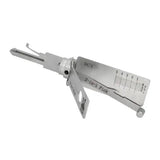
Your Lishi for 6-pin Schlage SC4 house locks
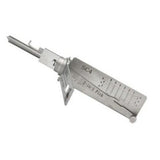
Your Lishi for 5-pin Kwikset KW1 house locks
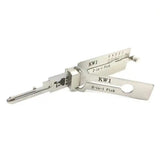
Your Lishi for 6-pin Kwikset KW5 house locks
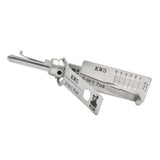
Your Lishi for an American Lock padlock
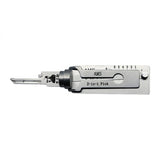
Your Lishi for Kwikset, 5 or 6 pins
Not sure which? Take both, 10% off the second.
The KW1 opens 5-pin Kwikset locks and the KW5 opens 6-pin. Take both and you have the right tool whichever of the two you meet.
KW1 Kwikset 5-Pin + KW5 Kwikset 6-Pin $81.69 $85.98
Your Lishi for Schlage, 5 or 6 pins
Not sure which lock you've got? A Residential Pack covers the common house locks
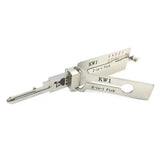
Your Lishis for the whole house
Not sure? Take this pack.
Kwikset and Schlage are the two biggest names in American house locks. This pack covers their two most common keyways, KW1 and SC1, plus the KW5 for 6-pin Kwikset, so you don't have to guess.
Residential Small Pack $106.99 $125.97 (save $18.98)
Rather start with one tool? The KW1 opens 5-pin Kwikset and the SC1 opens 5-pin Schlage.
Your Lishi for Hyundai and Kia
 Lishi HY17 Pick and Decoder
$52.11
Lishi HY20 Pick and Decoder
$52.11
Lishi KY14 Pick and Decoder
$52.11
Hyundai and Kia changed keyways across model years. Match yours on the vehicle list, then pick the profile it names.
Car locks change between trims, model years and markets, and one make can run two keyways in the same year. We match each profile to the cars it's built for, but small differences between locks mean we can't promise a fit on every car. Check your model and year on the vehicle list before you order. Our returns cover unused tools in their original packaging, so a Lishi that has been tried in a lock counts as used and can't come back.
Your Lishi for Chrysler, Dodge and Jeep
Car locks change between trims, model years and markets, and one make can run two keyways in the same year. We match each profile to the cars it's built for, but small differences between locks mean we can't promise a fit on every car. Check your model and year on the vehicle list before you order. Our returns cover unused tools in their original packaging, so a Lishi that has been tried in a lock counts as used and can't come back.
Your Lishi for VW and Audi
Newer VW Group cars use the HU162 series. The vehicle list tells you whether yours is the 8 or 9 cut.
Car locks change between trims, model years and markets, and one make can run two keyways in the same year. We match each profile to the cars it's built for, but small differences between locks mean we can't promise a fit on every car. Check your model and year on the vehicle list before you order. Our returns cover unused tools in their original packaging, so a Lishi that has been tried in a lock counts as used and can't come back.
Made for Kwikset KW5, not guesswork
The job
Use this tool when the lock profile matches KW5 and you want guided pin feedback plus decoding in one tool.
The fit
Lishi KW5 Kwikset 6-Pin Pick and Decoder is for matching 6-pin Kwikset KW5 cylinders. Brand name alone is not enough. Match the keyway profile.
How to use it
Start on known practice hardware, keep tension light, and move one numbered position at a time so the feedback stays readable.
One keyway, two useful jobs
Lishi tools are strongest when chosen precisely. The pick surface helps you work the pins in order, while the scale gives you a repeatable way to read the lock after successful movement.
How to tell if your lock is KW5
Start with the key blank
Look for a KW5 mark if your key has one, but do not stop there. Replacement keys can be stamped differently, so compare the blade profile and plug face as well.
Check for a six-pin lock
This is the 6-pin Kwikset tool. If your cylinder is the shorter five-pin KW1 setup, use the KW1 Lishi rather than trying to make this one fit.
Compare the side grooves
The warding and side grooves on the key must match the KW5 profile. A Kwikset logo on the lock is not enough; the keyway shape is the deciding point.
Confirm the profile, then work slowly
A Lishi is not a universal rake. Confirm the KW5 profile, insert the tool cleanly, apply controlled tension, and test the numbered pin positions one at a time. When the plug turns, use the grid to read the depth information the tool is designed to show.
- Match the exact KW5 keyway before ordering.
- Start with light tension and deliberate movement.
- If the job is strictly the five-pin Kwikset KW1 profile, compare the KW1 tool.
What to know before you buy
| Brand | Lishi |
| Tool type | 2-in-1 lock pick and decoder |
| Keyway | KW5, 6-pin |
| Best use | matching 6-pin Kwikset KW5 cylinders |
| Choose a different tool for | Other Kwikset profiles, automotive keyways, Yale, dimple, tubular, or non-matching cylinders. |

Pair it with the Beginners Visual Guide
Lishi tools make more sense when you understand binding order, tension, the shear line, and why pin positions feel different. The Beginners Visual Guide gives you 178 pages and 200+ full-color illustrations, including Lishi tool concepts in the wider lock picking toolkit.
Keep the guide next to your practice lock while you learn what the grid is showing. It is a separate companion, not part of this tool, and it gives newer pickers a friendlier way into precise keyway work.
Chris Dangerfield, founder: A Lishi rewards patience. The tool is clever, but the real value is that it slows the lock down for you. Match the keyway, keep your tension clean, and use the grid as a way to understand what your hands just felt.
Quick answers from the LockPickWorld bench
What is this used for?
It is used to pick and decode matching 6-pin Kwikset KW5 cylinders with one keyway-specific tool.
How do I know if it fits my lock?
Check for a KW5 mark when present, confirm you are dealing with a six-pin Kwikset, and compare the key blade grooves with the KW5 profile before buying.
Is this approachable while I am learning?
Yes, if you start on known practice hardware and take it slowly. The grid can make pin positions easier to understand than freehand picking alone.
What should I pair it with?
Use a matching practice cylinder if you have one, a standard pick set for freehand work, and the Beginners Visual Guide when you want the mechanism explained visually.
Add the KW5 Lishi to your bench
Choose it when the lock is a matching 6-pin Kwikset KW5 profile and you want one guided tool for pin feedback, depth reading, and cleaner practice sessions.
