
Dimple Locks Explained: How They Work, Where You Find Them, and How to Pick Them
A dimple lock is a pin tumbler lock whose pins press against dimpled pockets milled into the flat faces of the key, instead of the toothed edge. Most carry more pins than a standard cylinder and tighter manufacturing tolerances, which makes them noticeably harder to pick than the average pin tumbler. Dimple locks are the default high-security format across Europe.
Last updated:
Dimple locks turn a pin tumbler on its side and read it from the flat of the key. They carry more pins, tighter tolerances, and a reputation for resisting picking. Here is how the mechanism works, where you will run into one, how secure it really is, and the three ways to pick it.
What is a dimple lock?
A dimple lock is a variant of the pin tumbler mechanism. Instead of a toothed key edge, the key has small dimpled pockets milled into its flat faces, and the cylinder's pins press against those faces from the side or underneath. When the correct key enters the keyway, each pin meets a dimple of the precise depth needed to bring its pin pair to the shear line, and the plug can rotate.
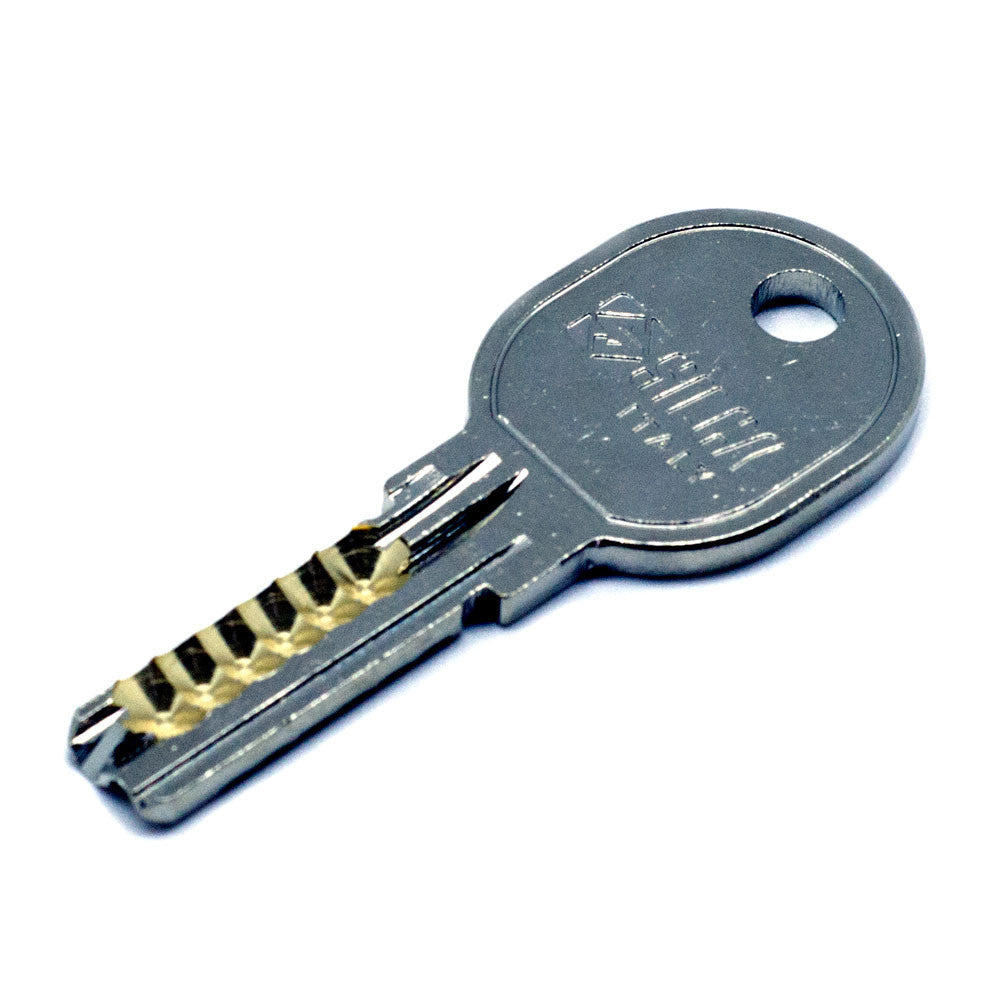
The mechanism is most strongly associated with European front-door cylinders and high-security padlocks. Mul-T-Lock, EVVA, ABUS, ISEO, and DOM are among the best-known dimple-cylinder makers.
How dimple locks work

Mechanically, a dimple lock is still a pin tumbler. Spring-loaded driver pins push key pins down into the plug, blocking it from rotating until every pin pair is lifted, or pulled outward, to align with the shear line. The difference is geometry: pins enter from the side or bottom of the keyway instead of the top, and they bear against the flat of the key rather than its edge.
That single change brings several practical advantages over a standard pin tumbler:
- More pins per cylinder. Dimple locks routinely run 6, 8, 10, or even 12 pin stacks where a residential pin tumbler typically has 5 or 6.
- Tighter tolerances. Mass-market dimple cylinders are machined to tighter dimensions than typical pin tumblers, so feedback is weaker and security pins set less obviously under the pick.
- Multiple pin rows. Some high-security designs use two or three rows of pins simultaneously, so every row must be lifted to the correct depth before the plug rotates.
- Sidebar augmentation. Higher-end dimple cylinders add a sidebar that reads notches on the key's sides, so the picker has to defeat both the shear line and a separate sidebar code.
Where you will find dimple locks
Dimple locks are the default high-security format across much of Europe and turn up wherever extra picking resistance is wanted:
- Front-door cylinders on European homes, particularly across Germany, Italy, the Netherlands, France, and the Nordic countries. Most euro-profile cylinders are available in both pin tumbler and dimple variants.
- Higher-security padlocks from brands such as ABUS, Mul-T-Lock, and EVVA.
- Commercial master-key systems where extra pinning depth simplifies the keying chart.
- High-end safe deposit box cylinders.
- US deadbolts from premium brands, most notably Mul-T-Lock.
In the US, dimple locks remain uncommon on residential doors but show up on imported euro-profile installations, premium deadbolts, and security-rated padlocks.
How secure are dimple locks?
Dimple locks sit toward the higher end of the security spectrum, but the range is wide. Three things determine how secure a particular dimple lock actually is:
- Pin count and pinning depth. A 6-pin standard-depth dimple lock is barely harder than a quality pin tumbler. A 10-pin dimple lock with multiple rows of pins is exponentially more demanding.
- Security pins. Spool, serrated, and T-pins resist picking the same way they do in a pin tumbler. High-security dimples often use security pins in every position.
- Sidebars and active elements. A sidebar adds a second layer that has to be solved alongside the shear line, and active key elements such as movable pins or magnetic interactives defeat most picking attempts outright.
A budget dimple cylinder offers similar real-world security to a mid-range pin tumbler. A well-specified high-security dimple from a recognized maker is one of the most picking-resistant common mechanisms you will meet.
How to pick a dimple lock

Three approaches work on most dimple locks. The right one depends on the cylinder in front of you, the time you have, and whether you need a working key afterwards.
1. Single-pin picking with dimple-specific picks
A dimple keyway is too narrow for a standard hook pick to reach the pins. A dimple pick has a different shape: it enters the keyway flat-on, reaches outward or downward to engage a pin from the side, and lifts it to the shear line. A complete dimple pick set typically pairs 4 to 8 differently-shaped picks with one or two dedicated dimple tension wrenches that grip on the flats of the keyway rather than its corners.
Single-pin picking a dimple lock is slower and more demanding than a pin tumbler. Pin feedback is weaker, multiple rows often have to be solved together, and security pins set less obviously. A clear dimple practice cylinder is the fastest way to build the muscle memory before attacking a real cylinder.
2. Raking with dimple rakes
Dimple rakes have profiles cut to roughly match common dimple spacings. Under light tension, a dimple rake can set easier dimple locks within a few passes. Raking is fast to attempt and rarely opens high-security dimples, but it is the right first move on residential dimple cylinders where you do not need to preserve the lock or cut a key.
3. Bump keys
Dimple bump keys exist for many of the most common dimple cylinders, including Mul-T-Lock and ISEO. The technique is the same as standard bumping: insert a bump key cut for the cylinder's keyway, apply light tension, and strike the key to transfer kinetic energy through the pin stacks. Bumping is faster than picking but unreliable on cylinders with anti-bump pins, sidebars, or active elements.
Dimple vs pin tumbler at a glance
Both mechanisms read the key with pins meeting a shear line. The geometry, pin count, and tolerances put them at very different places on the security curve.
| Dimple lock | Pin tumbler lock | |
|---|---|---|
| Mechanism | Dimpled pockets milled into flat key faces | Toothed cuts on the edge of the key |
| Common uses | European doors, high-security padlocks, euro cylinders | US doors, padlocks, deadbolts |
| Typical pin count | 6 to 12, sometimes multi-row | 5 to 6 |
| Security tier | Medium to high | Low to high (varies) |
| Pick difficulty | Hard to expert | Easy to expert |
| Best tools | Dimple picks, dimple rakes, dimple bump keys | Hook picks, standard rakes, security-pin techniques |
Both rows describe typical examples. A budget dimple is barely harder than a good pin tumbler; a high-security dimple is one of the most picking-resistant common mechanisms.
Dimple locks: frequently asked questions
Are dimple locks more secure than pin tumbler locks?
Are dimple locks more secure than pin tumbler locks?
Usually yes, but the gap depends on how the dimple lock is specified. A high-pin-count dimple cylinder with security pins and a sidebar is dramatically harder to pick than a standard residential pin tumbler. A budget 6-pin dimple cylinder without security pins is only marginally harder than a good pin tumbler.
What is the difference between a dimple lock and a pin tumbler lock?
What is the difference between a dimple lock and a pin tumbler lock?
Both use spring-loaded pins that must reach the shear line for the plug to rotate. In a pin tumbler, pins press against the toothed edge of the key from above. In a dimple lock, pins press against dimpled pockets milled into the flat faces of the key from the side or below. Dimple locks typically carry more pins and tighter tolerances.
Can I pick a dimple lock with a standard lock pick set?
Can I pick a dimple lock with a standard lock pick set?
Almost always no. Standard hook picks are shaped to reach pins from the top of a keyway and cannot engage pins through the flat of a dimple key blade. Picking a dimple lock requires dedicated dimple picks, which are shaped to reach the pins through the dimple-keyway geometry.
Are dimple locks used in the US?
Are dimple locks used in the US?
Yes, but they are uncommon on standard residential doors. Most US homes use pin tumbler deadbolts. Dimple locks show up on imported euro-profile cylinders, premium deadbolts from brands such as Mul-T-Lock, and on high-security padlocks. They are the default high-security format across most of Europe.
What tools do I need to pick a dimple lock?
What tools do I need to pick a dimple lock?
At a minimum, a dedicated dimple pick set with several pick profiles and dimple-specific tension wrenches. A clear dimple practice cylinder is the fastest way to learn. Dimple rakes speed up budget dimple cylinders. For specific cylinders such as Mul-T-Lock, a brand-matched dimple bump key is often the quickest entry method.
Can dimple locks be bumped open?
Can dimple locks be bumped open?
Many can. Bump keys cut to common dimple keyways such as Mul-T-Lock and ISEO are sold openly. Bumping a dimple lock is faster than picking it, but high-security cylinders with anti-bump pins, sidebars, or active key elements resist bumping entirely.
Are dimple locks a good choice for a front door?
Are dimple locks a good choice for a front door?
A high-security dimple cylinder from a recognized maker is one of the strongest pick-resistant options available for a residential door. The trade-off is cost, key cutting (specialist locksmiths only), and key availability. For a typical home, a quality pin tumbler deadbolt with security pins offers similar real-world protection at lower cost; for high-target homes or for keying convenience across many doors, a dimple deadbolt is worth the upgrade.
How many pins does a dimple lock have?
How many pins does a dimple lock have?
Most dimple cylinders carry 6 to 12 pin stacks, often in multiple rows. Mid-range European dimple cylinders typically run 6 or 8 pins on a single row. High-security designs run 10 or more pins, sometimes across two or three rows, with each row needing to be solved before the plug rotates.
Tools for picking dimple locks
Dimple locks are a different mechanism from pin tumblers and need dedicated tools. Three picking tools that cover the range, plus the visual guide that ties every mechanism together.

Honest Dimple Lock Pick Set
$37.99
Professional flag-type dimple picks for serious single-pin work. Multiple blade profiles to reach pins through the dimple keyway, paired with dimple-specific tension wrenches, in a leather wrap-up case. The pro-grade pick for cylinders that budget rake sets cannot touch.
Buy now
Clear Dimple Practice Cylinder
$17.99
A clear-bodied dimple cylinder. Watch the pins set against the dimpled pockets of the key as you pick. The fastest way to build dimple picking muscle memory before attacking a real cylinder on a door.
Buy now
Mul-T-Lock Dimple Bump Key
$17.50
A Garrison-keyway bump key cut for Mul-T-Lock dimple cylinders, the most common high-security dimple format in the US. Bumping is faster than picking when the cylinder allows it; works on standard Mul-T-Lock cylinders without anti-bump pinning.
Buy now
Beginners Visual Guide
$24.99
178 pages with 190+ cutaway diagrams and step-by-step illustrations covering every mechanism (pin tumbler, wafer, dimple, disc detainer, lever, and more) and the picking technique for each. Beginner to advanced.
Buy the guideFree US shipping on orders over $49. Every lock pick set ships with a free starter eBook.
See all dimple lock picks and tools, or read about the eight main types of locks and how they compare.