
How a Lishi works
A Lishi is two tools in one. It picks a lock open, pin by pin, and then reads the lock so you know exactly how its key is cut. Here's what happens inside the lock while you work, in three steps.
The parts of a Lishi

One tool, one moving needle. The blade slides into the keyway, the tension arm turns the whole tool like a key, the knob moves the picking needle from pin to pin, and the decoder grid shows how far each pin went.
- The bladeShaped to slide into specific The shaped slot you push the key into. Locks from different brands are often built for the same keyway, and one brand can use several, so match the slot and the key, not the logo. Each Lishi is made for the keyways named on it, so pick the one built for your slot., so it sits exactly where a key would.
- The The part of the tool that turns the lock's core gently, the way a key would. That light turning pressure is what holds each pin once you've lifted it to the right height.Turns the The round core in the middle of the lock. It's the part that turns when the right key is in. gently while you pick, so you don't need a separate tension wrench.
- The picking needleMoves to each numbered pin position and lifts one pin at a time.
- The Once the lock is open, the numbered grid on the tool shows how deep each pin sits. Those depths are the cuts on the key, so a locksmith can cut a brand new working key from them.Numbered marks that show how high each pin had to go. That's the key's cut depth.
Inside the lock, step by step
Slide it in and add light tension
Push the Lishi into the The shaped slot you push the key into. Locks from different brands are often built for the same keyway, and one brand can use several, so match the slot and the key, not the logo. Each Lishi is made for the keyways named on it, so pick the one built for your slot. as far as it goes and turn the The part of the tool that turns the lock's core gently, the way a key would. That light turning pressure is what holds each pin once you've lifted it to the right height. very gently, the way a key would turn. Each pin in the lock is a short stack: a key pin at the bottom and a driver pin above it, pushed down by a spring. At rest the driver pins cross the The thin gap between the plug and the lock body. When every pin is lifted to split exactly at that gap, the plug is free to turn., and that's what stops the lock turning.
Lift each pin to the shear line
Move the needle to the first numbered position and lift. When the gap between the two pins reaches the shear line, the light turning pressure catches the driver pin above it, and you feel a tiny give in the arm. That pin is set. Move to the next position and repeat. The numbers on the tool tell you which pin you're on.
The plug turns, then you read the code
With every pin set, nothing blocks the shear line and the The round core in the middle of the lock. It's the part that turns when the right key is in. turns. Now read the Once the lock is open, the numbered grid on the tool shows how deep each pin sits. Those depths are the cuts on the key, so a locksmith can cut a brand new working key from them. at each position. Pins that had to travel further give a different number from short ones, and the full row is the The list of cut depths along a key, one number per pin, read from the head to the tip. Give it to a locksmith and they can cut you a working key.. A locksmith can cut a working key from it without taking the lock apart.
Choosing your Lishi
Each tool is made for specific keyways, so start with the lock in front of you. Grab its key if you have it: the brand and often a code like KW1 or SC1 are stamped on the head, and the cuts along the top tell you how many pins it has.
A house door
Kwikset and Schlage are the two biggest names in American house locks. Match your key and you're done.
- Kwikset key with 5 cuts (often stamped KW1)Herramienta 2 en 1 de 5 pines Lishi Kwikset (KW1) original$42.99
- Kwikset key with 6 cutsHerramientas originales para ganzúas Lishi Kwikset (KW5) de 6 pines, 2 en 1$42.99
- Schlage key with 5 cuts (often stamped SC1)Herramienta 2 en 1 de 5 pines original Lishi Schlage (SC1)$39.99
- Not sure which? Take the packLishi Residential Small Pack:$106.99
A car door
Car locks change by make, model and year, so check your car on the list first. It names the profile to choose.
A padlock
American Lock padlocks have their own Lishi.
The AM5 is on its way back. See every Lishi we carry in the meantime.
Rather tap through it? The finder asks three quick questions and shows you the one that fits.
Find your Lishi in three taps
Each tool is made for specific The shaped slot you push the key into. Locks from different brands are often built for the same keyway, and one brand can use several, so match the slot and the key, not the logo. Each Lishi is made for the keyways named on it, so pick the one built for your slot.. Tell us what you're opening and we'll show you the pick and decoder that fits it.
What are you opening?
Which brand is on the lock?
The brand name is usually stamped on the key head or the face of the lock. Many keys also carry a code such as KW1 or SC1 near the head.
Look straight into your lock. Which slot matches?
Hold the lock with the pins at the top, as it sits in the door.
How many cuts does your key have?
- Hold your key flat with the round head on the left and the bumpy edge on top.
- Each V-shaped dip along that bumpy edge is one cut.
- Count the dips from the head to the tip. We've numbered them on the drawings so you can match yours.
Still unsure? A 6-cut key is a little longer than a 5-cut key of the same brand. Lay yours next to the drawings, or tap Not sure and we'll cover both.
See a small second slot beside the keyhole? That's a Kwikset SmartKey lock, which uses its own rekeying mechanism. The KW1 and KW5 are made for standard Kwikset pin locks.
Which make is the car?
Your Lishi for 5-pin Schlage SC1 house locks
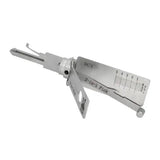
Your Lishi for 6-pin Schlage SC4 house locks
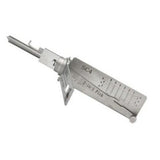
Your Lishi for 5-pin Kwikset KW1 house locks
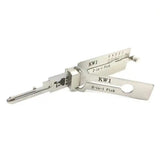
Your Lishi for 6-pin Kwikset KW5 house locks
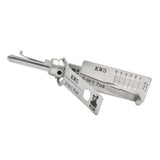
Your Lishi for an American Lock padlock
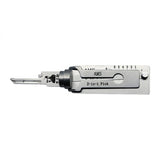
Your Lishi for Kwikset, 5 or 6 pins
Not sure which? Take both, 10% off the second.
The KW1 opens 5-pin Kwikset locks and the KW5 opens 6-pin. Take both and you have the right tool whichever of the two you meet.
Herramienta 2 en 1 de 5 pines Kwikset (KW1) original + Herramientas originales para ganzúas Kwikset (KW5) de 6 pines, 2 en 1 $81.69 $85.98
Your Lishi for Schlage, 5 or 6 pins
Not sure which lock you've got? A Residential Pack covers the common house locks
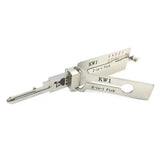
Your Lishis for the whole house
Not sure? Take this pack.
Kwikset and Schlage are the two biggest names in American house locks. This pack covers their two most common keyways, KW1 and SC1, plus the KW5 for 6-pin Kwikset, so you don't have to guess.
Residential Small Pack $106.99 $125.97 (save $18.98)
Rather start with one tool? The KW1 opens 5-pin Kwikset and the SC1 opens 5-pin Schlage.
Your Lishi for Hyundai and Kia
Hyundai and Kia changed keyways across model years. Match yours on the vehicle list, then pick the profile it names.
Car locks change between trims, model years and markets, and one make can run two keyways in the same year. We match each profile to the cars it's built for, but small differences between locks mean we can't promise a fit on every car. Check your model and year on the vehicle list before you order. Our returns cover unused tools in their original packaging, so a Lishi that has been tried in a lock counts as used and can't come back.
Your Lishi for Chrysler, Dodge and Jeep
Car locks change between trims, model years and markets, and one make can run two keyways in the same year. We match each profile to the cars it's built for, but small differences between locks mean we can't promise a fit on every car. Check your model and year on the vehicle list before you order. Our returns cover unused tools in their original packaging, so a Lishi that has been tried in a lock counts as used and can't come back.
Your Lishi for VW and Audi
Newer VW Group cars use the HU162 series. The vehicle list tells you whether yours is the 8 or 9 cut.
Car locks change between trims, model years and markets, and one make can run two keyways in the same year. We match each profile to the cars it's built for, but small differences between locks mean we can't promise a fit on every car. Check your model and year on the vehicle list before you order. Our returns cover unused tools in their original packaging, so a Lishi that has been tried in a lock counts as used and can't come back.
Why a Kwikset Lishi opens other brands
A Lishi doesn't read the name on the box. It follows the The shaped slot you push the key into. Locks from different brands are often built for the same keyway, and one brand can use several, so match the slot and the key, not the logo. Each Lishi is made for the keyways named on it, so pick the one built for your slot., the shaped slot the key slides into, and the spacing of the pins behind it. Plenty of locks sold under other names are built on the Kwikset or Schlage keyway. When one of them is a standard pin tumbler lock with the same pin count, the matching Lishi slides in and works it just the same.
It works the other way round as well. Kwikset now sells some of its SmartKey locks on the Schlage SC1 keyway, so the logo alone can point you the wrong way. Go by the key, the slot and the pin count.
- Read the key. Many keys carry a blank code such as KW1 or SC1 stamped on the head or blade, whatever logo sits next to it. That code tells you which Lishi family to look at.
- No key? Try one. If a Kwikset or Schlage key slides all the way into the keyhole, you're on the right keyway family. Then count the pins.
- Match the pins. On these keyways, a 5-pin lock takes the 5-pin tool (KW1 or SC1) and a 6-pin lock takes the 6-pin tool (KW5 or SC4).
One lock needs a different approach: a SmartKey lock, the kind with a small rectangular reset slot beside the keyhole. It uses its own mechanism even when it takes a Kwikset-shaped key, so these standard pin tumbler tools aren't made for it.
Words you'll meet
- Keyway
- The shaped slot you push the key into. Locks from different brands are often built for the same keyway, and one brand can use several, so match the slot and the key, not the logo. Each Lishi is made for the keyways named on it, so pick the one built for your slot.
- Plug
- The round core in the middle of the lock. It's the part that turns when the right key is in.
- Pin count
- How many pin stacks sit inside the lock. Each pin lines up with one cut on the key, so a lock with six pins takes a longer key with one more cut.
- Shear line
- The thin gap between the plug and the lock body. When every pin is lifted to split exactly at that gap, the plug is free to turn.
- Tension arm
- The part of the tool that turns the lock's core gently, the way a key would. That light turning pressure is what holds each pin once you've lifted it to the right height.
- Decoder
- Once the lock is open, the numbered grid on the tool shows how deep each pin sits. Those depths are the cuts on the key, so a locksmith can cut a brand new working key from them.
- Key code
- The list of cut depths along a key, one number per pin, read from the head to the tip. Give it to a locksmith and they can cut you a working key.
- Cuts
- The dips along the top edge of the key. Each dip lifts one pin in the lock, so counting them tells you how many pins the lock has.
New to lock picking?
A Lishi is made for specific keyways. To learn how pins and tension feel on any lock, start with a beginner set and clear practice locks, then add the Lishi for the locks you meet most.